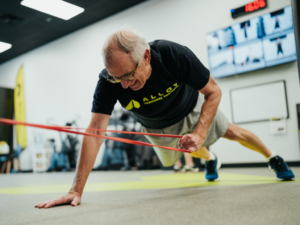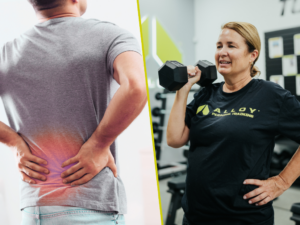
Whether you are returning to exercise, managing stiffness, staying active as you age, or simply trying to train smarter, joint-safe workouts can help you build strength while reducing unnecessary stress on your knees, hips, shoulders, and back.
Staying strong should help you move better, feel better, and enjoy life more—not leave you feeling beat up. At Alloy Personal Training, we believe fitness should be personalized, sustainable, and built around how your body moves today. The goal is to challenge your muscles in a smart, controlled way that supports your joints instead of wearing them down.
What Are Joint-Safe Workouts?
Joint-safe workouts are strength and conditioning sessions designed to improve fitness while minimizing excessive impact, poor movement patterns, and unnecessary strain on the joints. They focus on proper form, controlled tempo, appropriate resistance, mobility, stability, and recovery.
Training while keeping joints safe can be very effective for building muscle, improving balance, increasing endurance, and supporting long-term health. The difference is that every exercise is selected and coached with intention.
For example, instead of jumping into high-impact moves or heavy lifts without preparation, a joint-safe approach may use controlled squats to a box, cable rows, resistance bands, dumbbells, sled pushes, step-ups, or supported single-leg exercises. These movements can still challenge the body, but they allow for better alignment, control, and progression.
Why Joint Health Matters In Strength Training
Your joints are involved in every movement you make. When they are supported by strong muscles, mobile tissues, and good movement mechanics, daily activities become easier. Climbing stairs, carrying groceries, getting up from the floor, playing with kids or grandkids, and enjoying recreational activities all depend on healthy joint function.
The problem is that many people associate exercise with discomfort. They may have tried group classes, online workouts, running programs, or gym routines that left their knees aching, shoulders irritated, or lower back tight. Over time, that discomfort can lead to inconsistency—or stopping altogether.
A better approach is to train in a way that strengthens the muscles around the joints. Strong glutes can support the hips and knees. A strong core can help protect the lower back. Strong upper-back muscles can improve shoulder position. Better balance and mobility can reduce compensations and make movement feel smoother.
The Key Principles Of Joint-Safe Workouts
The best Joint-Safe Workouts are built on a few important principles.
1. Form Over Intensity
How you move matters. A well-coached exercise should place stress on the muscles you are trying to train, not on areas that are not prepared to handle it. Small adjustments in foot position, range of motion, posture, or grip can make a big difference.
2. Appropriate Resistance Levels
More weight is not always better. The right load is one that challenges you while allowing you to maintain control. As your strength improves, resistance can increase gradually.
3. Personalized Range Of Motion
Not everyone needs to squat to the same depth, press overhead, or perform the same variation of an exercise. Joint-safe training respects your current mobility and builds from there.
4. Gradual Progression
The body adapts well when stress is introduced in manageable steps. Doing too much too soon is one of the most common reasons people feel worn down.
5. Recovery Planning
Muscles and joints need time to adapt. A complete fitness program includes warm-ups, cooldowns, mobility work, rest, and proper nutrition.
Low-Impact Does Not Mean Low-Result
One of the biggest myths in fitness is that you have to jump, run, or push through pain to get results. That is simply not true. Low-impact training can be incredibly effective when it is programmed correctly.
Strength training is one of the best examples. Exercises like deadlifts, rows, presses, lunges, step-ups, carries, and core work can build muscle and improve function without repetitive pounding. Machines, cables, dumbbells, kettlebells, suspension trainers, and resistance bands can all be used to create joint-friendly options.
Conditioning can also be joint-safe. Instead of high-impact cardio, many clients benefit from options like cycling, rowing, incline walking, sled work, battle ropes, or circuit-style strength training. These methods can raise the heart rate without the same impact forces as jumping or running.
The key is personalization. What feels joint-safe for one person may not feel right for another. That is why coaching matters.
How Alloy Personal Training Supports Joint-Safe Strength
At Alloy Personal Training, workouts are designed for real people with real goals, real schedules, and real bodies. Our small group personal training model allows clients to get the benefits of expert coaching in a supportive and motivating environment.
Before jumping into a program, it is important to understand how someone moves, what their goals are, and whether they have limitations or previous injuries that need to be considered. From there, exercises can be modified to match the client’s ability level.
A client with knee sensitivity, for example, may start with supported squats, hip-dominant movements, glute strengthening, and step variations that build confidence. Someone with shoulder discomfort may benefit from neutral-grip pressing, rowing, postural strength work, and mobility drills. A person returning after time away from exercise may begin with simple movement patterns and gradually progress as strength and endurance improve.
This personalized approach helps clients feel successful while still making measurable progress.
Examples Of Joint-Safe Workout Movements
A well-rounded joint-safe strength session may include a warm-up, lower-body strength, upper-body strength, core stability, conditioning, and flexibility work.
For the lower body, exercises like box squats, glute bridges, Romanian deadlifts, step-ups, and supported split squats can build strength while allowing control. These movements help target the glutes, hamstrings, quadriceps, and hips.
For the upper body, cable rows, chest presses, lat pulldowns, landmine presses, and dumbbell carries can strengthen the back, chest, shoulders, and arms with adjustable resistance and joint-friendly positioning.
For the core, exercises like dead bugs, planks, Pallof presses, and bird dogs can improve stability without excessive twisting or crunching. A strong core helps transfer force efficiently and supports the spine during daily movement.
For conditioning, low-impact circuits can include sled pushes, bike intervals, rowing, farmer’s carries, or medicine ball work performed with good technique.
The best part is that each exercise can be scaled. The movement can become easier, harder, more supported, or more dynamic depending on the client’s needs.
Listen To Your Body Without Losing Momentum
Joint-safe training does not mean avoiding all discomfort. Muscles may burn, breathing may get heavier, and workouts should feel challenging. However, sharp pain, joint pinching, numbness, or discomfort that changes your movement should not be ignored.
A smart training environment helps you distinguish between productive effort and warning signs. Coaches can adjust the exercise, change the range of motion, reduce the load, or substitute a better movement. This allows clients to keep training without forcing exercises that are not the right fit.
Consistency is where results happen. When workouts feel good on the body, clients are more likely to show up, build momentum, and stay committed.
Nutrition And Recovery Support Joint Health
Exercise is only one part of the equation. Nutrition and recovery also play an important role in how your body feels and performs.
Protein supports muscle repair and growth. Hydration helps the body function properly. Nutrient-rich foods provide vitamins and minerals that support overall health. Sleep gives the body time to recover from training. Mobility work, walking, and active recovery can also help reduce stiffness and improve movement quality.
While no single food or supplement can replace a smart training plan, healthy habits outside the gym can make your workouts more effective and sustainable.
Who Can Benefit from Joint-Safe Workouts?
Almost everyone can benefit from a joint-safe approach. It is especially helpful for adults who want to build strength without high-impact training, beginners who need coaching and structure, people returning after a break, active adults who want to stay strong as they age, and anyone who has felt discouraged by workouts that were too intense or uncomfortable.
The goal is to train for life. That means building strength you can actually use—without feeling like your workouts are taking more from your body than they give.
Build Joint Health And Strength For The Long Run
Fitness should help you move with confidence, not fear. With the right plan, the right coaching, and the right progression, Joint-Safe Workouts can help you get stronger, improve mobility, protect your joints, and feel better in everyday life.
At Alloy Personal Training, we specialize in helping clients train smarter so they can stay consistent and enjoy lasting results. Your workouts should meet you where you are, support where you want to go, and help you build a stronger body without unnecessary wear and tear.
Ready to feel stronger, move better, and train with confidence? Alloy Personal Training is here to help. Let us know how we can support your fitness journey.